Over the last few years, trying to buy a second-hand car in Ireland has been roughly as pleasant as logic-checking a toddler. We had the pandemic, which stopped factories making microchips, which meant nobody could buy a new car. Then we had Brexit, which meant importing a sensible, well-specced diesel saloon from anywhere in Britain suddenly required paying a mountain of customs duties, VAT, and something called VRT—which I’m convinced stands for *“Very Ridiculous Tax.”*
The result? The price of a three-year-old family hatchback skyrocketed by an absurd 85%. It was a dark, post-apocalyptic wasteland where a battered 2014 Volkswagen Golf with high mileage was treated with the same financial reverence as a rare piece of Renaissance art.
But now, we are well into 2026, and I have marvellous news. The madness has stopped. The second-hand car market in this country has finally relaxed, rubbed its eyes, and returned to something resembling sanity. It is, dare I say it, a buyer’s paradise. But before you rush out to the nearest forecourt with your pockets stuffed with euros, you need to understand the new rules of the road. Because everything has flipped on its head.
Let us start with the biggest shock of all: the rise of the battery-powered milk float.
For years, early adopters bought brand-new electric vehicles (EVs), patted themselves on the back for saving the polar bears, and ignored the looming monster of depreciation. Well, that monster has arrived, and it has eaten their wallets. Manufacturers started slashing the prices of brand-new EVs, which instantly pulled the rug out from under the used ones.
According to the latest market indices, if you compare a three-year-old electric car to its identical diesel brother, the EV is now a staggering 11% *cheaper* upfront. A typical three-year-old family EV sits at a median price of roughly €28,800. The equivalent diesel? Almost €36,000. That is a €7,000 discount just for opting for a plug instead of a nozzle.
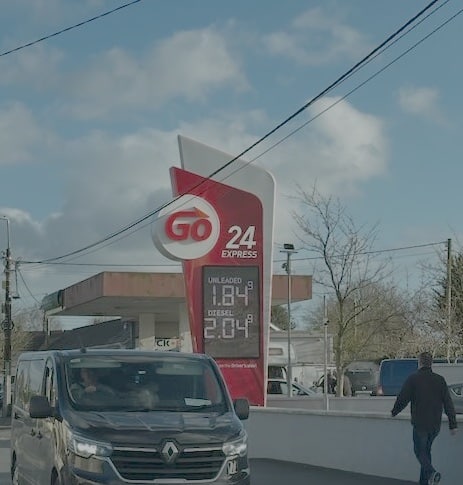
And the financial witchcraft doesn’t stop there. If you cover a fairly standard 17,000 kilometres a year, feeding a petrol car will cost you about €2,200 annually. Fueling a diesel will run you around €2,000. But if you plug an EV into your house at night? You’re looking at about €780. It’s the closest thing to legal bank robbery available on the market today.
As a result, Irish buyers have spotted the bargain. The used EV market exploded by over 30% recently. If you look at Irish forecourts today, used electric cars are flying off the lots. Just under 6% of used EVs linger on a dealer’s lot for more than 90 days, compared to nearly 16% for traditional petrol and diesel cars. The fastest-moving machine of the lot? The MG4, which dealers are shifting in an average of just 22 days, is closely followed by the ubiquitous Volkswagen ID.4 and the Tesla Model 3.
But what if you don’t want an electric car? What if the idea of planning your afternoon around a public charging point fills you with cold, existential dread?
Well, the average Irish car-buying budget has crept up to a record €21,300. And if you walk into a dealership with that kind of money, you are no longer limited to high-mileage, basic-spec transport. That sweet spot between €18,000 and €25,000 is currently awash with brilliant, nearly-new petrol models and highly sensible hybrids.
The undisputed kings of the Irish tarmac remain the family crossovers and SUVs. If you wander through any supermarket car park in Leinster, Munster, or beyond, you will notice that half the population seems to drive a Hyundai Tucson, a Kia Sportage, or a Toyota Yaris Cross. Because they are elevated, practical, and rugged enough to survive the average Irish pothole—which, let’s be honest, usually resemble craters on the moon—they hold their value like bars of solid gold.
If you want absolute bulletproof reliability, you buy a used Toyota hybrid. If you want cavernous space for golf clubs, dogs, and children, you buy a Skoda Octavia. These are the cars that keep the country moving, and because we are now changing our cars more frequently—every 5.2 years on average down from 5.6—the supply of these mid-market gems is healthier than it has been in a decade.
There is, however, one dark, frustrating corner of this automotive utopia: the budget end of the market.
If you are a student, a first-time driver, or simply someone who views a car as an appliance and only has €5,000 to spend, I’m afraid I have bad news. While the top and middle of the market have cooled down beautifully, prices for cars under €6,000 actually rose by over 7% year-on-year. There is a persistent, stubborn shortage of decent, cheap runabouts. You will still find people demanding €4,500 for a 2008 supermini that smells of damp dogs and has a suspicious clunking noise coming from the suspension.
Worse still, once you buy a budget car, you have to insure it. And trying to get a reasonable insurance quote in Ireland remains an absolute car crash. You can buy a perfectly sensible, small-engined hatchback for €3,000, only for an insurance company to look at your lack of a No Claims Bonus, stroke their chins, and demand the price of a small Mediterranean island just to cover you for twelve months.
So, what is the grand conclusion?
If you are looking for a cheap, €3,000 runabout to park on the street, may God have mercy on your soul. It is still a tough, cutthroat world out there.
But if you have a decent budget, are looking to trade up, or have been secretly eyeing up a sleek, nearly-new family cruiser, the Irish second-hand market has never looked better. You can skip the long waiting lists for a brand-new vehicle, sidestep the worst of the depreciation curve, and, if you are brave enough to buy a car that plugs into the wall, you can save enough money on fuel to buy yourself a very nice lunch. Every single week.
The dark days of the overpriced used car are officially in the rearview mirror. Happy hunting.